In Marco’Frauchiger’s studio at the Cité International des arts in Paris, an artistic investigation explores the largely hidden history of Swiss-made Pilatus PC-6 aircrafts used during the ‘Secret War’ in Laos, some of which crashed during the conflict. Far from a mental image, the artist-researcher seeks to demonstrate the result of his reticular thinking. Marco Frauchiger is Swiss; he doesn't want to be a detached photojournalist but rather to confront his country's history, even if it's uncomfortable.
In the short story City of glass, written by Paul Auster in 1985, the author explores the dual meaning in English of the term “private eye” (page 22)—that is, “détective privé” in French. He enjoys drawing a parallel between the sound of the word “eyes” and the personal pronoun “I”. Behind the letter “I” in “Private I” lies both the investigator and the personal pronoun “I”; these two meanings form the anxious echoes of a subject. This term, used to describe an investigator, can be compared to the visual artist—a man with two heads—who deals with private matters in full view of the public. And then there is the eye nestled within “Private Eye.” Based on this splendid interpretation by Paul Auster, one might wonder whether the photographer-detective, through the insights revealed by his mood board, is also investigating a part of himself.
This “art/actvist”—a deliberate portmanteau of “artist” and “activist”—seeks not only to shed light on the secrets history has kept hidden and its shortcomings, but also to use what history has discarded to create a new way of seeing and thinking. Building his own camera from the wreckage of the shot down plane, he poses the same question to the audience that Godard did: What does the camera do?
As soon as he asks what the camera does, he provides the answer. It is no longer so much what it does; rather, it is ontologically a subject insofar as it is an object created from what it shows.
In Godard’s work, the camera breaks with convention: it can be shaky, and the editing sometimes cuts in mid-shot, reminding the viewer that they are watching a film. Marco’s installation shares this same intention; he intervenes by adding a photograph of his photographic machine to remind the viewer that they are looking at photos produced by this handmade device, as well as photographs of other archival documents he has collected to give meaning to his investigation.
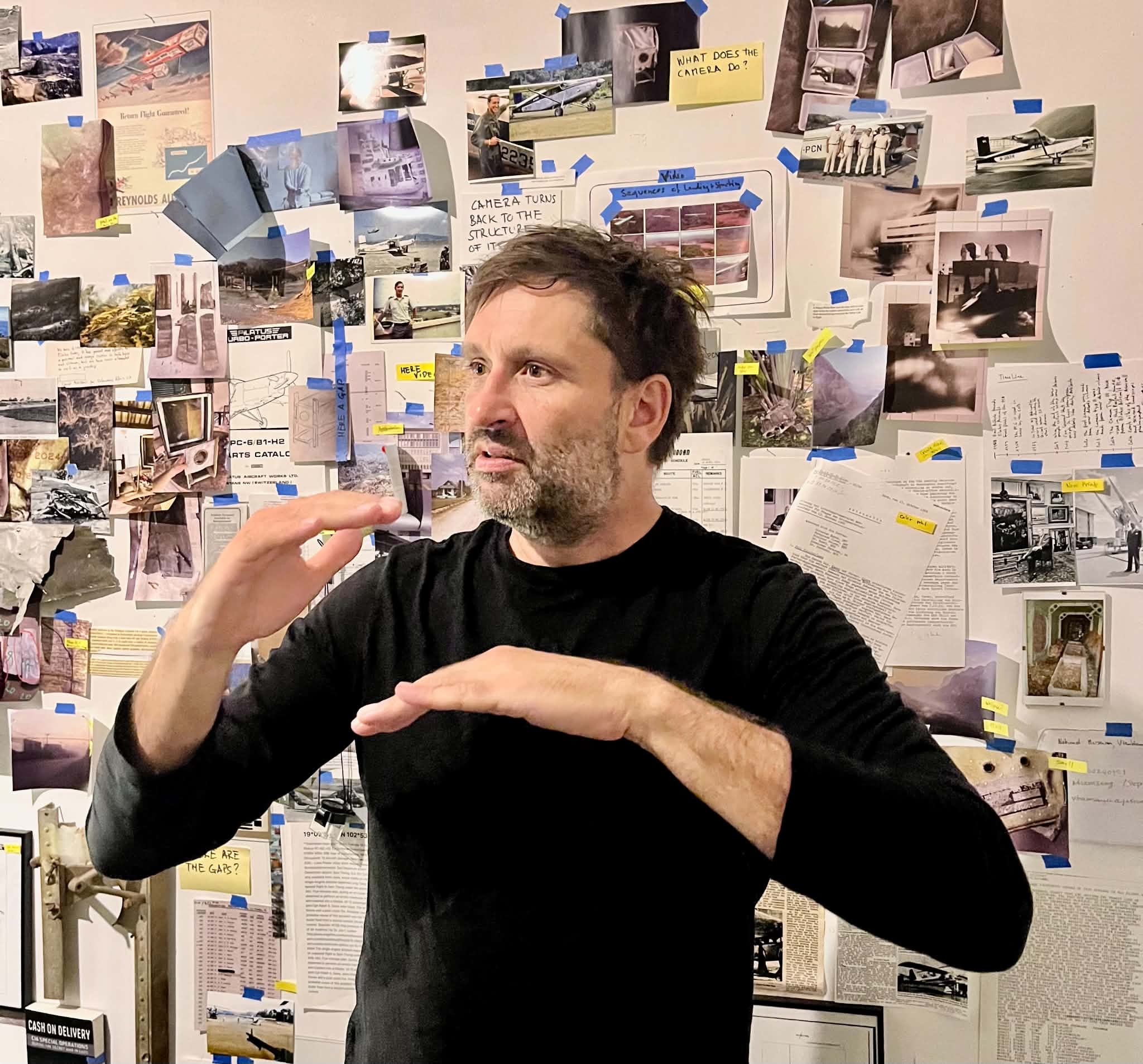
The artist-researcher seeks to present the findings of his investigation, which confronts the CIA’s silence and the gaps in a history that refuses to be written. He attempts a narrative that leaves the viewer facing a wall. The expression “to be face to the wall” is commonly used in French to describe a difficult situation in which one is faced with an inevitable choice, with no possible alternative. This expression originates from the prison system, as prisoners, flanked by guards, would find themselves facing a wall in front of which they were led to be executed. In this interpretation, the wall symbolizes the end of any possibility of escaping one’s fate, and the expression conveys the resignation and powerlessness of the person standing before it. Another theory suggests that the expression may have military origins. Indeed, in the trenches during World War I, soldiers often found themselves backed up against a wall of earth, unable to move forward or backward. This desperate situation then became a metaphor for any situation in which one finds oneself with no choice but to face an imminent difficulty or danger.
Whatever its exact origin, the expression “to be face to the wall” is now used more generally to describe deadlock or dilemma situations. It's a way to mean being confronted with a situation where there are no other alternatives. Marco Frauchiger silently urges the audience to make a decision and take action to ensure that the disaster does not happen again.